
REVIEW · KATHMANDU HIKING TOURS
10 Days Annapurna Base Camp Trek from Kathmandu
The mountains are the main event. This 10-day Annapurna Base Camp trek takes you from Kathmandu to Pokhara, then through Gurung villages, forest trails, stone stairways, and the Annapurna Sanctuary. I like the private trip format, which gives your own group a guide rather than placing you in a large mixed party. I also like the route’s variety, from Fewa Lake and Ghandruk to sunrise at Annapurna Base Camp. The main drawback is the pace: several days involve roughly six hours of walking, with plenty of uphill and downhill steps, while meals and drinks cost extra.
This is a practical route for someone who wants a guided Himalayan trek without arranging every transfer alone. You get Kathmandu and Pokhara transport, permits, a guide, basic mountain lodging, and a private car for the final road transfer from Nayapul. The $586.67 price is attractive for what it covers, though you should budget separately for food, drinks, tips, and emergency rescue costs.
Key points to know before booking
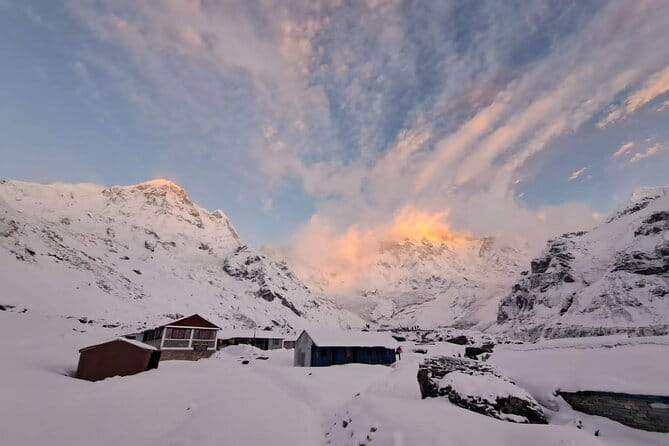
- Sunrise at Annapurna Base Camp: Day 7 begins with changing light on Annapurna South, Hiunchuli, Annapurna I, Gangapurna, and Machhapuchhare.
- Gurung village stay: Ghandruk adds local culture and stone-paved village walking before the higher mountain stages.
- Private group arrangement: Only your own party participates, with an English-speaking guide during the trek.
- Long road transfers: Kathmandu to Pokhara takes about seven hours by tourist bus in each direction.
- Basic mountain lodging: Pokhara includes two-star hotel accommodation, while the trek uses basic guest houses.
- Moderate fitness required: Expect repeated climbs, descents, forest paths, suspension bridges, and thousands of stone steps.
Why this 10-day route works
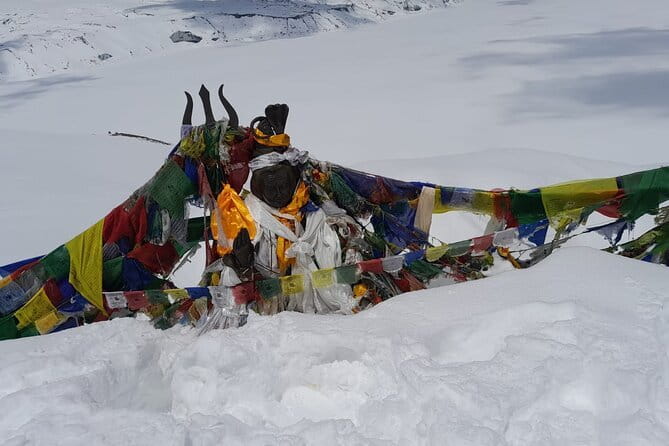
The appeal of this trek is its clear progression. You begin with city-to-city travel, move into traditional villages, follow the Modi River through forest, reach Machhapuchre Base Camp and Annapurna Base Camp, then retrace part of the route before returning to Pokhara and Kathmandu.
That structure gives you several kinds of Nepal in one trip. Pokhara provides a gentle start and finish beside Fewa Lake. Ghandruk offers village scenery and Gurung culture. The middle days bring the more serious walking, with the route narrowing into the Annapurna Sanctuary and the peaks closing in around you.
I also like that the trip is private. If your group has five people, as some past parties have, you can share the experience with friends without adjusting to a busload of strangers. It also gives you a direct relationship with the guide. Guides named in past trips include Prakash and Bisham, both praised for being helpful and friendly.
Still, private does not mean effortless. This is not a sightseeing holiday with occasional walks. You should be comfortable walking for five to six hours on mountain trails. The route includes steep staircases and repeated climbs, especially around Chhomrong and the approach to base camp.
More Annapurna Treks in Kathmandu:
- Annapurna Circuit Trek with Tilicho Lake
★ 5.0 · 368 reviews - Annapurna base camp trek 5 Days
★ 5.0 · 252 reviews - 14-Day Private Annapurna Base Camp Trek
★ 5.0 · 180 reviews
Kathmandu to Pokhara: seven hours before the walking starts
Your first morning begins with hotel pickup in Kathmandu at 6:30 am. You are taken to the bus station for a tourist bus to Pokhara, a road journey of about seven hours.
This is useful and economical, but it takes up most of the day. You will not reach the trail on Day 1. Instead, you arrive in Pokhara, transfer to a hotel in the Lakeside area, and have Fewa Lake within walking distance.
That overnight in Pokhara is more than a simple stopover. It breaks up the long road journey and gives you a calmer base before the trek. The included accommodation is described as two-star level, so expect practical comfort rather than a luxury hotel. The location near the lake is the useful part. You can walk out for a meal or a look at the waterfront without arranging another ride.
The tourist bus transfer is included in both directions. One particularly useful detail is that a request for a sofa seat was accepted easily by the operator on a past trip. You can ask about seating when booking, but it should not be treated as a guaranteed feature.
Ghandruk brings village life into the route
On Day 2, the trek moves to Ghandruk, a well-known Gurung village. The walk takes about six hours and follows a stone-paved trail.
Ghandruk is an important change of mood. You are no longer simply passing through a city or riding between destinations. The stone track and village setting give the trip a human scale, with homes, local paths, and mountain views sharing the same space.
The description does not specify the exact road transfer or trail starting point for this day, so you should confirm the morning arrangements with your guide. What is clear is that Ghandruk is reached on foot and that the day is substantial. The stone paving can be tiring, particularly if you are not used to long uphill walks.
This is also the point where the trip begins to feel like a real trek rather than a transport package. You spend time moving at walking speed, with the opportunity to notice local settlements and the changing views.
Chhomrong means stairs, forest, and steady effort
Day 3 heads toward Chhomrong. The route climbs to Kimrung Hill, descends to Kimrung Khola through forest, passes a village settlement near the river, then climbs again toward Chere Hill.
The six-hour estimate hides the main challenge: this is a day of repeated changes in direction. You climb, descend, and climb again. A river crossing and forest sections add variety, but the terrain is not flat walking.
Chhomrong is a key point on the route because it marks a more demanding stage of the journey. You should pace yourself here rather than treat the early days as a race. Your guide can help with the rhythm, but your own fitness and patience matter more than speed.
The private format helps on days like this. You can discuss the walking pace with your guide and take breaks suited to your group. The experience is not designed for a large public group moving on a fixed schedule.
A few more hikes around Kathmandu worth a look
- Everest Base Camp Trek – 14 Days
★ 5.0 · 1,499 reviews - Everest Base Camp Trek
★ 5.0 · 842 reviews - Everest Base Camp Trekking
★ 5.0 · 485 reviews - Nagarkot Sunrise View and Day Hiking from Kathmandu
★ 5.0 · 471 reviews
Bamboo and Doban follow the Modi River
Day 4 is another six-hour walking day, beginning with a descent toward the Chomrung River. The route uses thousands of stone staircases and crosses a suspension bridge before climbing back to Sinwa Village.
From Sinwa, the trail becomes milder through the forest toward Bamboo, then continues to Doban on the bank of the Modi River. This is one of the most varied walking days. You get stairs, a bridge, river scenery, forest, and small settlements in one stretch.
The word thousands matters. Stone steps are not just a scenic detail here. They can place more strain on your knees and legs than a steady dirt path. Good footwear and a moderate pace will make a major difference, though the tour only specifies that you need moderate physical fitness.
Doban’s riverside setting gives the day a strong sense of progress. You are moving deeper into the mountain route, while the forest and river keep the scenery from becoming a single repeated view.
Deurali is a shorter day, but not an easy one
On Day 5, you trek to Deurali in about five hours, following a mountain trail with views.
The shorter walking time gives you a little breathing room before the base camp stage. It is still a mountain day, and the route continues to gain ground through uneven terrain. You should not assume that five hours will feel easy after the stair-heavy days around Chhomrong and Bamboo.
Deurali is useful as a staging point. The next day brings Machhapuchre Base Camp and Annapurna Base Camp, so this overnight stop breaks the approach into a manageable section. The accommodation during the trek is in basic guest houses, which means the focus is on location and shelter rather than hotel-style amenities.
Food and drinks are not included in the tour price. They are available for purchase, so keep that cost in mind each day. The positive side is flexibility: you buy what you need as you go. The less convenient side is that the advertised price does not cover your regular meals.
Machhapuchre Base Camp and the final climb
Day 6 is the central approach to the destination. You trek to Machhapuchre Base Camp, then continue uphill for about two hours to Annapurna Base Camp.
The views named for this stretch include Hiunchuli, Annapurna South, Annapurna I, Annapurna III, Gandharvachuli, and Gangapurna. Machhapuchre, also called Fishtail, adds one of the route’s most recognizable peaks.
This is the day when the trek’s earlier effort pays off, but it is also a day to conserve energy. The five-hour estimate includes the approach to Machhapuchre Base Camp and the further climb to Annapurna Base Camp. The final two hours can feel significant after several previous days on foot.
Annapurna Base Camp is the destination, not merely another viewpoint. The setting places you among major peaks on several sides, and the route’s focus shifts from villages and forests to the open mountain surroundings. If the weather cooperates, this should be the strongest visual moment of the trip.
Sunrise at Annapurna Base Camp
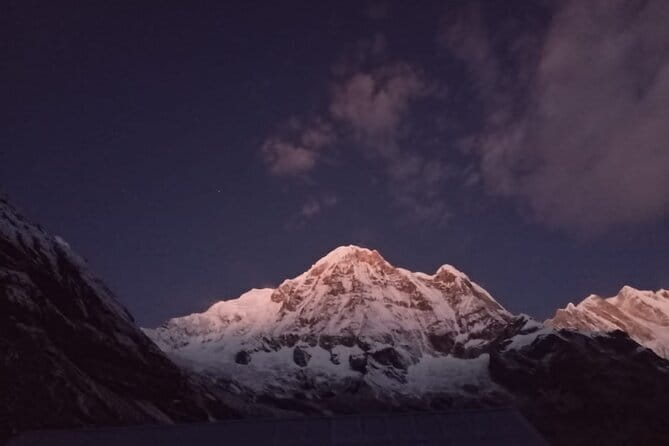
Day 7 starts at base camp with sunrise. The peaks change from white to orange, and the route description highlights a 360-degree mountain view.
The named peaks include Annapurna South, Hiunchuli, Annapurna I, Gangapurna, and Machhapuchre. This early start is worth taking seriously. The light changes quickly, so you should be ready before sunrise rather than treating the morning as a relaxed departure.
After the sunrise, you begin the descent to Bamboo, a six-hour day. The return is not a simple stroll downhill. Long descents and stone steps can be hard on tired legs, even when the route is technically easier than the climb up.
This is also why the seven-day base camp schedule makes sense. You do not rush immediately from Annapurna Base Camp all the way back to the road. The overnight at Bamboo gives you a defined return stage before the final villages and vehicle transfer.
Jhinu Danda adds a possible hot spring stop
Day 8 takes you toward Chhomrong and then down to Jhinu Danda. A hot spring is located about 15 minutes from the village if you choose to visit.
The hot spring is an optional extra rather than a guaranteed centerpiece. The route information gives the walk as six minutes, but that figure does not fit the described trekking day, so you should confirm the expected walking time with the guide. The important practical point is that this remains a walking day with a descent to Jhinu Danda.
This stop gives the final section a pleasant change. After the mountain views and long trail days, the possibility of a hot spring offers a more relaxed break. Bring any personal items you would need for that visit, since they are not listed among the inclusions.
Nayapul, Pokhara, and the long ride back
Day 9 continues down to Nayapul, with about six hours of trekking. From there, a private car takes you to Pokhara in roughly one hour and ten minutes, followed by a short transfer to your Lakeside hotel.
The private car is a useful inclusion after a long walk. You are not asked to continue by public transport after reaching the road. Returning to the same Lakeside area also makes the trip easy to follow: you have one night near Fewa Lake before the final journey.
Day 10 repeats the road connection in reverse. You transfer to the bus station, take a tourist bus for about seven hours to Kathmandu, and finish the trip there.
The two long bus days are the least exciting part of the experience, but they are part of the value calculation. The Kathmandu to Pokhara and Pokhara to Kathmandu transfers are arranged and included, so you do not need to solve the intercity transport yourself. You do need patience. If you want a shorter overall trip, this schedule may feel road-heavy.
What the $586.67 price really covers
At $586.67 per person, the trip offers solid value for a private, 10-day arrangement. The price includes hotel pickup and drop-off, tourist bus transport between Kathmandu and Pokhara, two-star accommodation in Pokhara, basic guest houses during the trek, the private car between Pokhara and Nayapul, trekking permits, TIMS, and an English-speaking guide.
That is a useful package. Permits and transport can be awkward to organize separately, and a guide adds practical support on a route with river crossings, stairs, forest paths, and multiple overnight stops.
The price does not include meals or drinks. Rescue costs in an emergency are also excluded, and tips are optional rather than included. You should treat the advertised price as the core trip cost, not the final amount you will spend.
The strongest value comes if you already have a small group. A private trip lets you share transport and guide arrangements with your companions while keeping the walking schedule within your own party. Solo value may feel different, but the data provided does not specify a separate solo supplement or group-size price scale.
Guides, service, and the private format
The human side of this trip receives strong praise. Prakash and Bisham are named as guides who were friendly, helpful, and attentive. Past groups also praised the wider support team, vehicle arrangements, and the feeling of being treated more like friends than customers.
That matters on a trek. A guide is not just there to point at peaks. You need someone who can help keep the group moving, explain the route, and make the transition between Kathmandu, Pokhara, trail villages, and road transfers easier.
The operator is Couch Adventure Nepal, and the tour is described as private. Only your group participates. Confirmation is provided at booking, and the stated start time is 6:30 am for the first pickup.
The cancellation rule is straightforward but firm: you receive a full refund if you cancel at least three full days before the local start time. Cancellations or changes inside that period are not accepted for a refund.
Who should book this trek?
I would recommend it to you if you want a classic Annapurna Base Camp route with transport from Kathmandu already arranged. It suits a small group of friends, couples, or relatives who can manage repeated six-hour walking days and prefer a private guide.
It is also a good match if you value village scenery as much as the final viewpoint. Ghandruk, Chhomrong, Bamboo, Doban, Deurali, and Jhinu Danda make the route more than a quick climb to base camp.
I would be cautious if you want luxury accommodation, included meals, short travel days, or a relaxed walking schedule. The guest houses are basic, the roads take many hours, and the stone staircases demand real effort. You should also confirm the Day 8 timing and ask about current transport arrangements before departure.
Should you book the Annapurna Base Camp trek?
Book this trek if you want strong mountain scenery, a private guide, and a fairly complete transport package at a moderate price. The best parts are the Gurung village setting, the changing route through forest and river country, sunrise at Annapurna Base Camp, and the personal service associated with guides such as Prakash and Bisham.
Choose another option if you need a higher-end hotel standard or an all-inclusive price. For an active small group that accepts basic lodgings, extra meal costs, and long bus journeys, this is a sensible way to reach Annapurna Base Camp from Kathmandu without handling every detail alone.
FAQ
How long is the Annapurna Base Camp trek from Kathmandu?
The experience lasts approximately 10 days, including the road journeys between Kathmandu and Pokhara at the start and end.
What time does the tour begin?
Hotel pickup in Kathmandu is scheduled for 6:30 am on the first day.
Is transport from Kathmandu to Pokhara included?
Yes. Tourist bus transfers from Kathmandu to Pokhara and from Pokhara back to Kathmandu are included.
Is accommodation included?
Yes. Two-star hotel accommodation in Pokhara and basic guest house accommodation during the trek are included.
Are meals and drinks included?
No. All meals and drinks are excluded, but they are available for purchase.
Is the trek private?
Yes. Only your own group participates in this private tour and activity.
What fitness level is required?
The tour states that you should have a moderate physical fitness level. Walking days generally last about five to six hours and include climbs, descents, stone staircases, forest trails, and a suspension bridge.
Is a trekking guide provided?
Yes. An English-speaking trekking guide is included during the trek.
What is the cancellation policy?
You can receive a full refund if you cancel at least three full days before the experience start time. Cancellations or changes made less than three full days before the start are not accepted for a refund.
Just added around Kathmandu
- Annapurna Base Camp Trek – 11 Days★ 5.0 · 30 reviews
- Annapurna Base Camp Trek 12 Days★ 5.0 · 18 reviews
- Annapurna Base Camp Trek 10 Days★ 5.0 · 35 reviews
- Annapurna Base Camp Trekking★ 5.0 · 38 reviews
- Adventurous Annapurna Base Camp Trekking★ 5.0 · 7 reviews
- Annapurna Base Camp Trek★ 5.0 · 80 reviews
- Annapurna Base Camp Private Short Trek★ 5.0 · 8 reviews
- Annapurna Base Camp Short trek★ 5.0 · 13 reviews
Kathmandu Hiking Tours, compared.
Nagarkot Sunrise View and Day Hiking from Kathmandu
Read our review →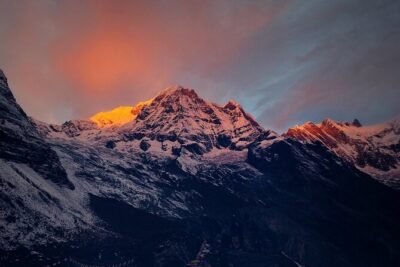
Browse the lists this tour appears in